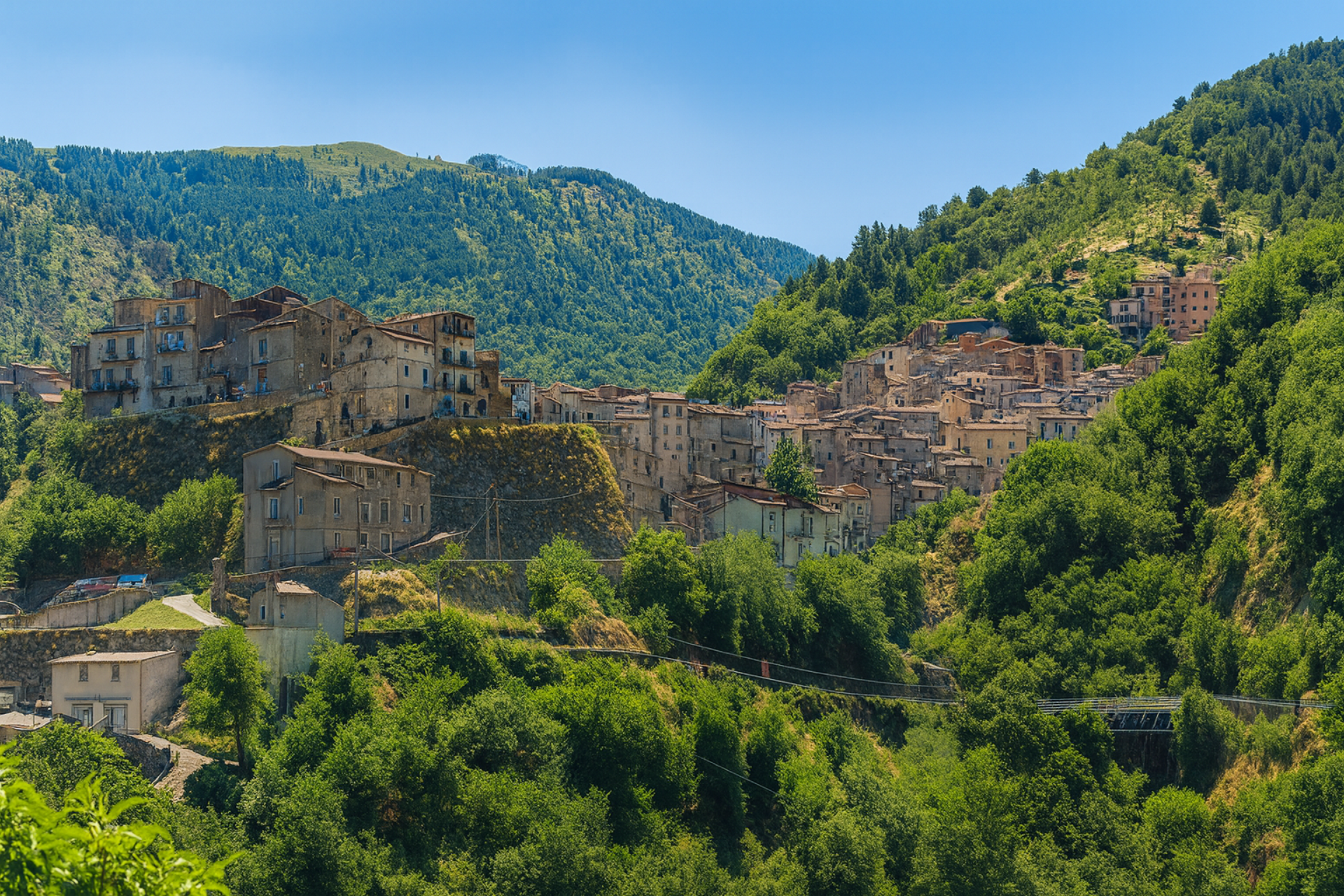
Longobucco: the weavers' village in the heart of the Sila Greca
Longobucco is an ancient village in the province of Cosenza, located at about 800 meters above sea level in the heart of the Sila Greca, within the Sila National Park. The town is nestled between deep valleys, dense forests, and clear waters, particularly those of the Trionto River, which flows at the foot of the town.
Its location, immersed in pristine nature, makes it one of the most evocative places in the Calabrian hinterland.
Longobucco has very ancient origins: the area was already inhabited in the Greek and Brettian era, while during the Middle Ages it became an important center of Basilian culture, thanks to the presence of Eastern monks.
The name may derive from the Latin longus buccus (long ravine), referring to the morphology of the site, or from Lombard influences, although the latter theory is considered less likely.
The village was also known in the past for its silver mines, which operated for centuries and were exploited even during the Roman and Bourbon eras.
Textile tradition: the “bucita”
Longobucco is famous throughout Calabria for its ancient textile tradition. The bucita is the traditional blanket of Longobucco, a true masterpiece of Calabrian textile craftsmanship. It is more than a simple artifact: it represents centuries of history, symbols, identity, and knowledge passed down from generation to generation, becoming one of the most important cultural emblems of the Sila Greca.
The bucita tradition has its roots in the Middle Ages, when the art of weaving with manual wooden looms, the processing of local wool, and the presence of Basilian monks, who introduced techniques and decorations inspired by Byzantine art, developed in Longobucco.
For centuries, weaving was one of the main economic activities of the town, especially among women.
Nature and Landscape
Longobucco is a perfect place for those who love pristine nature and slow tourism, boasting a rich natural landscape: forests of beech, larches, and firs, hiking trails in the Sila National Park, waterfalls, streams, and tributaries of the Trionto River, and mountain landscapes ideal for trekking, mountain biking, hiking, and photography.
The village retains a charming historic center, with stone houses, narrow streets, and panoramic views. Among the main places of interest are:
- Church of San Domenico, dating back to the 16th century
- Mother Church of Santa Maria Maddalena
- Remains of ancient mines and structures linked to the metallurgical tradition
- Ancient stone bridges over the Trionto River
Completing the village's charm are numerous popular traditions and religious festivals, deeply rooted in community life.
Gastronomy and Traditions
Longobucco cuisine is rich and authentic, based on local products, reflecting the strong connection with the mountains and rural traditions:
- Sila porcini mushrooms
- Homemade pasta (lagane, fusilli, maccheroni al ferretto)
- Traditional cured meats and cheeses
- Meat dishes typical of the mountain area
- Holiday desserts